
Heather Hopkins, MD at NextWealth
Discretionary Managed Portfolio Services (MPS) assets are set to pass £200bn after surging by a third (32%) in a year to £190bn, according to NextWealth’s latest MPS Proposition Comparison Report 2025.
The market’s growth defied expectations of a slowdown, according to NextWealth.
Its report showed assets grew by £46bn to £190bn in the 12 months to the end of September, powered by strong inflows into the sector’s biggest players.
Of the assets added in the past year, £28.6bn was from 10 firms (62% of net growth). The top two ranked firms, Quilter Wealth Select and Tatton, together now control 25% of market assets, NextWealth said.
However, while these two dominate the rankings and growth, the report reveals the whole sector continues to grow. Only three firms saw net outflows over the year, and 37 of 49 included in the report achieved percentage growth above that of the MSCI World Index.

On top of that, the report found that growth across the sector looks set to continue, with a net 21% of 296 advisers surveyed planning to increase their allocation to discretionary MPS over the next 12 months. Among advisers currently using MPS, 48% expect to increase their use over the period, while of those advisers building their own portfolios, 30% expect to increase their use of MPS.
Heather Hopkins, managing director of NextWealth, said: “We are often asked if we have hit ‘peak MPS’. The evidence points to a firm no. The findings support our view that use of discretionary MPS will continue to increase, both among advisers already using them and those currently building their own portfolios.
“MPS remains the investment solution of choice and, given that MPS still only makes up 21% of adviser platform assets, there is a huge amount of room to grow.”
Notably, for the first time in four years, the report also found that advisers have increased the number of DFMs they use. In 2020, advisers were partnering with 2.5 DFMs on average, but by 2024 that had shrunk to 1.3 due to growing complexity and a need for consistency under Consumer Duty. The new report shows the trend reversing, however, with advisers increasing the average number of DFMs used to 1.7.
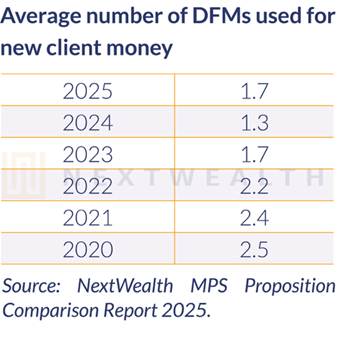
Hopkins said that illustrated a growing desire among advisers to offer a broader range of options given high equity market concentration. “In our interviews with DFMs, we heard that advisers have been reassessing their CIPs to ensure they offer a diversified set of asset allocation approaches. Some, for example, want at least one panel option that is underweight the US or the ‘Magnificent Seven’. In some cases, they want a contrarian investment philosophy to have a more rounded toolkit.”
• The results in the report were based on interviews with 22 representatives of DFMs operating MPS on platform. Data requests completed by 55 DFMs. Pricing analysis was conducted across 423 portfolios. Survey of 296 financial advice professionals, conducted in June and July.
Promote your vacancy to thousands of professionals on Financial Planning Jobs
Our specialist jobs service Financial Planning Jobs can help you reach nearly 12,000 financial professionals. You can set up an Employer Profile and post your job the same day on Financial Planning Jobs (terms apply). Dozens of Financial Planning and Paraplanning firms have used our affordable service to recruit new talent.
Offer: Use code 'FPJSaver10' on checkout to save 10% on your listing. Click for details:jobs.financialplanningtoday.co.uk/