
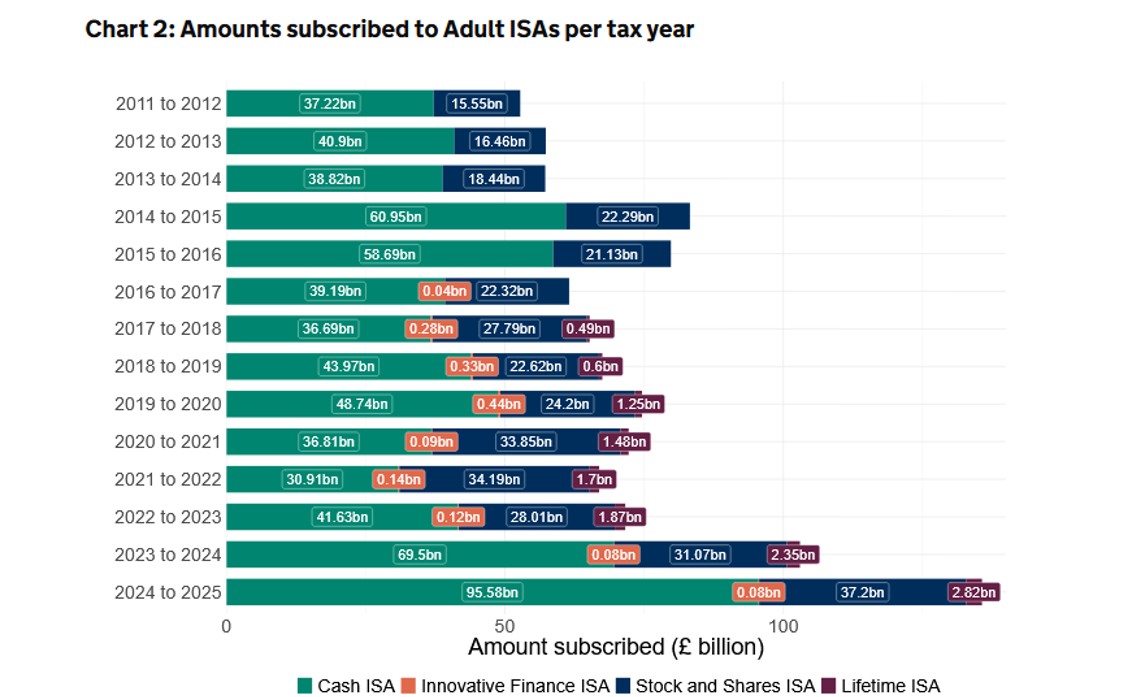
Around £135.7bn was subscribed to adult ISAs in 2024 to 2025, an increase of £32.7bn compared to 2023 / 2024 - with Stocks and Shares ISA subscriptions increasing by 20% to £31.3bn.
In 2024/25 the number of adult ISA accounts rose 12% to 16.8m, up from 15m in 2023/24 and from 12.4m in 2022/23.
The upward trend in new accounts is largely attributable to the increase in the number of Stocks & Shares ISAs subscribed to (802,000 new accounts to over 4.89m total).
The number of cash accounts subscribed to rose to 10.71m, representing 64% of all accounts.
Despite the increase in Stocks & Shares ISA subscriptions, the majority of the expansion in terms of volumes saved was driven by the rise in Cash ISA subscriptions, which grew by 38% to £95.6 bn.
Winston Ruddick, senior Financial Planning consultant at financial services consultancy Broadstone, said: “Higher interest rates and looming reforms have turbocharged the appeal of Cash ISAs, with savers taking advantage of stronger returns to stash billions more pounds into these accounts.
“The scale of the increase is striking with higher savings rates clearly making cash a far more attractive proposition, while the tax-free wrapper has become increasingly valuable as more savers find their interest income exposed to tax.”
From April 2027 the annual Cash ISA limit for savers under the age of 65 will fall to £12,000, while the overall ISA allowance remains at £20,000, in a move the Government hopes will push more savers towards investing.
Andy Murphy, CEO of Murphy Wealth, said the rise in the number of Stocks & Shares ISAs is encouraging to see.
He said: “Today’s figures are a positive step in the right direction, but they represent only a small reversal of a much larger, longer-term trend.
"Reversing that will require longstanding attitudes towards money to change. Encouraging more people to invest through education, guidance, and incentives, rather than allowing their wealth to sit on the sidelines in cash, should benefit both their own financial situation and the wider economy.”
Marianna Hunt, personal finance specialist at Fidelity International, said that the annual savings data demonstrates that the appetite for investment is growing but the Government needs to build more momentum if it is to help people understand the potential benefits of investing.
She said: “Although more people are investing, cash continues to attract the lion’s share of ISA money. Savers poured £95.6bn into cash ISAs in 2024-25, up c38% in a single year. By comparison, £37.2bn went into stocks and shares ISAs, an increase of around 20%. Overall, almost £2.60 went into cash ISAs for every £1 invested through a stocks and shares ISA.
“Higher interest rates have made cash more attractive in recent years, with HMRC pointing to increased returns on savings as one factor behind the rise in cash ISA subscriptions. Of course, everyone should have an accessible cash buffer for emergencies. But for money that won’t be needed for five years or more, investing offers greater potential for long-term growth, albeit with more risk along the way.”
Jim Reeve, interim managing partner at advice firm Continuum, added that the popularity of ISAs is also likely to have been boosted by their use for estate planning.
He said: “The 2024/25 tax year saw former Chancellor Rachel Reeves announce her plans to subject pensions to inheritance tax from 2027, leaving many savers looking for other ways to pass on their wealth to loved ones rather than the tax man. Whilst the full details of how this will work are still under review, many are already reviewing their estate planning options to make sure they can still pass on as much of their wealth as they can IHT-free.
“ISAs appear to be one of the unintended winners of this policy change, with considerable increases in both the number of subscribers and the amount subscribed despite savers continuing to face rising costs likely to be at least in part due to the plans to tax unused pension funds.”
The annual savings statistics also showed that 50,000 more savers paid penalties than bought a home with Lifetime Individual Savings Accounts.
In 2024/25 99,750 people used a Lifetime ISA to purchase the first home, withdrawing more than £1.5bn towards property purchases. However, 153,100 LISA savers made unauthorised withdrawals during the same period, triggering £119m in withdrawal charges.
Rachael Griffin, tax and Financial Planning expert at wealth manager Quilter, said the data demonstrates why the LISA needs reform.
She said: "The Lifetime ISA attempted to serve two very different purposes by helping people save for both a property purchase and retirement, and that complexity has often created confusion and undermined confidence and its good that reform is on its way.”