
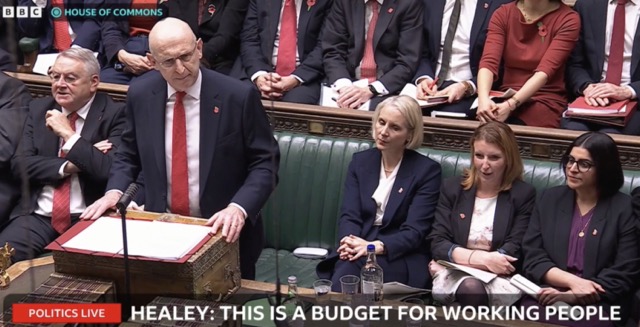
Chancellor John Healey predicted his Autumn Budget 26 will bring Britain's finances "into the black" within three years.
He said the OBR has upgraded its forecast for UK growth this year to 1.2%.
Mr Healey said the Budget was for the "working people of Britain, for British businesses big and small." He said it was built on "fiscal discipline" and will give Britain some "breathing space."
The Chancellor warned that the UK faces "global economic storms" pointing out that the war in the Middle East has driven up costs on families and businesses. He also pointed out that inflation has risen, driven by higher oil and gas prices.
He warned that "there are real challenges ahead", but said Britain has "beaten the forecasts this year" and believes it "can beat the forecasts again."
Mr Healey said the OBR forecast predicts we will spend £14bn more on debt interest this year. He said the government's financial headroom will fall from £24bn to £15bn, OBR.
He said according to the OBR forecast, borrowing will be down to 1.8% by 2030/31. On debt as a percentage of GDP, he said it is forecast to fall to 81.7% in 2031/32.
The government's tax and spending plans as set out by the Chancellor included cuts in business rates, a rise in the surcharge on banks and plans to devolve local tax revenues.
For individuals the announcements included a rise in the living wage, help with fuel bills, a new tax-free allowance for low-income pensioners.
The Chancellor said he will cut business rates to zero for 70,000 businesses by raising the threshold for those who have to pay it from premises with a rateable value of £12,000 to £18,000.
He said banks will pay an extra 3% on the banks’ surcharge, which will be "time-limited" to pay for immediate support on energy bills. It will start in January and end 15 months later, he says.
He announced plans to devolve tax revenues, calling it a "roadmap to fiscal devolution." He said: "From next year, 20% of business rates revenue will go to mayors," and from 2028 "a share of income tax receipts will go to mayors as well." He predicted that "100% of business rates will be retained locally by the end of the decade."
The Chancellor confirmed that the National Living Wage will climb to £13.21 an hour and the 18-20 National Minimum Wage to £11.27, with the move benefiting around 2.3m workers.
He announced a £100 payment for 20m households in council tax bands A-D in England to help deal with rising energy bills, with equivalent funding for Scotland, Wales and Northern Ireland. He also said standing charges will be removed from household gas bills.