
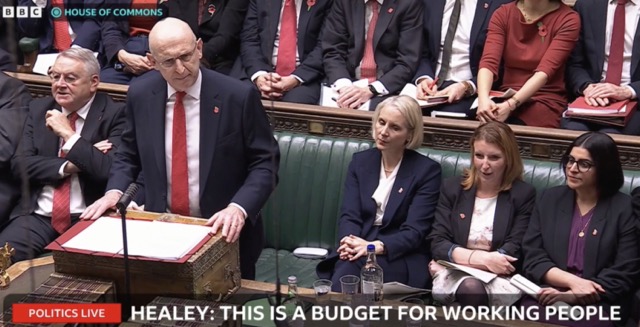
This is the full text of the Chancellor's Budget 2026 speech today in the Commons as provided by the Treasury. Note any political comments made by the Chancellor during his speech have been redacted by the Treasury.
Madame Deputy Speaker, thank you.
This is a Budget for the working people of Britain.
For British businesses, big and small,
Delivered at a time when global uncertainties and pressures are swirling worldwide and hitting people here at home.
A Budget built on fiscal discipline…
…which matches immediate action today, with clear direction for the future.
First, by giving Britain some breathing space on the cost of living and the cost of business,
Second, by backing the enterprise of British business to unleash innovation and growth in every postcode,
And third, by tackling the big challenges on energy, on national security, on public service procurement and transformation and on housing.
In this Budget, I will set out the new approach this administration is taking,
Led by the vision of our new Prime Minister, demonstrated in our first 100 days
Demonstrated in our first 100 days and carried through today’s Budget, the 10-Year Plan for Britain, and the Spending Review next year.
To steer us through the global economic storms today,
To chart a new course for Britain in the years ahead,
To give people fresh hope for Britain’s future.
Madame Deputy Speaker, it is an honour to stand here as Chancellor of the Exchequer to deliver my first Budget,
And I had hoped that I’d be the most closely watched member of the Government this week, until the Prime Minister went on Gogglebox.
But at the outset of this Budget statement, I want to pay tribute to my predecessor, my RHF the member for Leeds West and Pudsey, Britain’s first ever female Chancellor, after 800 years.
She brought fiscal discipline to this country,
And she took the decisions required to boost investment, to cut NHS waiting lists and to lift half a million children out of poverty.
And I also want to thank my outstanding team of Treasury Ministers and officials for preparing this Budget,
And the Office for Budget Responsibility for producing today’s forecasts.
Madame Deputy Speaker, analysts like to speak of economic headwinds. But what we face today are global economic storms with trade tensions acting as a drag on global growth, and Putin’s illegal invasion of Ukraine approaching now the end of its fifth year.
The OBR sets out that the war in the Middle East is a key driver affecting their forecasts today.
And this government continues to work with our allies to end the conflict and restore shipping through the Strait of Hormuz.
Madame Deputy Speaker, we did not want this war…
[REDACTED POLITICAL CONTENT]
It’s a war that has driven up costs on British families and on businesses.
Inflation, which was due to fall earlier this year to the 2% target, has now risen, driven by higher oil and gas prices,
Oil is up from around $70 a barrel to well over $100; and gas prices have nearly tripled since February.
For families, that means higher prices at the pump, higher energy bills, higher mortgages,
For businesses, it means higher running costs and more expensive loans.
And the impact is felt in public finances too.
Driven by the conflict in the Middle East, government borrowing costs across the G7 are reaching highs not seen for decades and in today’s forecast, the OBR predict that we will spend £14bn more on debt interest this year.
Those are the storms we face. We can’t wish them away. We must choose the course we steer through them.
And fiscal discipline is my first commitment as Chancellor,
More than ever, it underwrites every promise this government makes to the British people.
In the Budget today, I meet the fiscal rules –
The stability rule: that day-to-day spending must be covered by tax receipts,
And the investment rule, that government debt – defined as public sector net financial liabilities – must be falling as a percentage of GDP.
This year for the first time, I must meet these rules in the third year of the forecast. And I do.
My plans continue to reduce government borrowing o we spend less on debt interest and more on the priorities of the British people.
First, the stability rule, in the Budget today, I have chosen to use some of the headroom established last year to absorb the impact of the Iran war to protect the economy, and to protect family budgets.
My choices in this Budget mean I have kept the [REDACTED POLITICAL CONTENT] promise not to raise tax on working people.
And I have also rejected broad-based tax rises, or slashing public services, recognising that families and businesses need this breathing space.
Madame Deputy Speaker, the OBR confirms today that headroom against the stability rule is £15bn in 2029/30, before rising to £22bn in 2030/31.
That is what a buffer is for. Use it when you need it. Rebuild it when you can.
And so, despite the global challenges, this Budget puts us on track to eliminate the current budget deficit and get Britain’s finances into the black within 3 years.
Madame Deputy Speaker, as a [REDACTED POLITICAL CONTENT] government, last year, we cut borrowing to its lowest level in six years - from 5.1 to 4.4% of GDP.
I continue that work today. In today’s forecast, borrowing falls to 4.2% this year, 3.4 next year, 2.9 in 28/29, 2.1 in 29/30, and 1.8 in 30/31 and 31/32.
Our debt as a percentage of GDP is 83.2% this year, 83.8 next year and in 2028/29,
Before falling to 83.1 in 29/30, 82.3 in 30/31 and 81.7 in 31/32.
It is because of our [REDACTED POLITICAL CONTENT] decisions and [REDACTED POLITICAL CONTENT] plans, the International Monetary Fund has said that the UK now ‘stands out’ as a country where, and I quote “action to reduce the debt and deficit has been taken decisively”.
They project our UK deficit will be the lowest in the G7 by 2029.
[REDACTED POLITICAL CONTENT]
During this year of global economic shocks, forecasters predicted that the UK economy would slow down,
Those predictions of gloom were about as accurate as the predictions of who was going to be Chancellor.
Madame Deputy Speaker, Britain is defying expectations,
In the first half of this year, our economy was the fastest growing in the G7, alongside the US.
That is testament to the British People - the innovators, the business leaders, and the workers on the front line.
And its testament to the [REDACTED POLITICAL CONTENT] decisions taken over the last two years.
Government investment - up!
Business investment – up!
Productivity – up!
And real wages – up! More since the election than in the first ten years of the previous [REDACTED POLITICAL CONTENT] government.
I will never be complacent – but these are signs of resilience in the UK economy,
Madame Deputy Speaker, three months ago, the Bank of England upgraded their forecasts for UK growth this year,
Two weeks ago, the IMF did the same,
And today, the OBR has upgraded its forecast too – to 1.2% this year.
Followed by 1% next year, 1.6% in 2028, 1.8% in 2029, 1.7% in 2030 and 1.6% in 2031.
Yes, there are real challenges ahead, but Britain has beaten the forecasts this year,
And with the action I’m taking today, I believe Britain can beat the forecasts again.
Madame Deputy Speaker, despite the resilience of our economy,
I know that people are under pressure.
Too many people feel this country isn’t working well for them.
And in particular, households and businesses face challenges from rising energy costs, due directly to the conflict in the Middle East.
In the face of that, what matters is how we respond as a government and my choice in the Budget today is to give families and businesses some breathing space now,
And to begin the radical reform of energy to reduce bills in the future.
Last week, my RHF the Energy Secretary approved the Jackdaw gas field, boosting our energy security.
This will protect hundreds of jobs and adding an estimated £2.9bn to the UK economy. A pragmatic, common-sense decision.
And alongside that, I launched a new Energy Wealth Fund for the UK.
Today I’m setting a new course on energy: to get UK energy costs down in line with Europe.
From this point, our [REDACTED POLITICAL CONTENT] Government priority is first and foremost cheaper energy, with clean power key to achieving this.
This is possible because of the progress we’ve made towards clean power over the last two years, and this government remains unshakably committed to Net Zero by 2050,
This will demand deep reform of our energy system.
Starting at the Budget today and carried through the 10-Year Plan into the months and years ahead.
Madame Deputy Speaker, for many years, under previous [REDACTED POLITICAL CONTENT] governments, policy costs were loaded onto household bills through levies. Today, I am putting an end to that.
We will introduce a new Cost Control Framework to drive down all aspects of energy bills and I will scrap the upcoming Gas Shipper’s Obligation – a levy to fund hydrogen projects – and instead back those projects directly from government.
And I’m making further big changes to bring bills down in the long term.
First, on clean power generation, this government will only buy and build new projects when they lower bills and when they can connect to the grid.
Second, we will further break the grip of international gas prices on our bills by moving more of our old renewables onto fixed-price contracts.
And third, we will build cheaper, faster grid connections through GB Grid, and reform the complex web of institutions that govern the system.
This is how we deliver radical change Britain needs on energy.
It won’t happen overnight, and so I’m taking immediate action to give families and businesses breathing space in the here and now.
In the first week of this new government, we took VAT off electricity for 29 million households,
Today I’m extending that VAT cut through the winter and spring to July, taking £50 off the annual price cap.
And for business, our new British Industrial Competitiveness Scheme, will take 25% off electricity bills for 10,000 firms at the heart of British industry.
It will go live in April, and I confirm that we will make backdated payments for energy costs this year too.
Next year, working with my RHF the Energy Secretary, we will go further to make bills fairer.
Gas standing charges – these cost people over £100 a year, regardless of how much gas they use.
So, from next year, through Ofgem, we will remove standing charges from household gas bills,
and we will set out similar reforms to follow for electricity bills.
Madame Deputy Speaker, let me say this to families at home.
I know that with the conflict in the Middle East, rising energy bills are a real worry.
I know that people look to government at times like this, not to solve all their problems, but to give them a bit of breathing space.
So today, I am taking one further step.
This winter, for 20 million households in council tax bands A-D I am announcing a £100 energy payment for households.
Paid directly into people’s bank accounts to deal with rising energy bills a £2.6bn scheme to take the pressure off in the coldest months and see people through to the Spring.
The Scottish, Welsh and Northern Ireland governments will receive their share of this funding,
And I call on them to do the same and give people of all nations of the UK breathing space on their energy bills.
Madame Deputy Speaker,
£50 off VAT
£100 off Council Tax
For this winter, two tax cuts
For next year, fairer bills
And for the long term, radical reform of the energy market to produce cheaper power.
Breathing Space now, Hope for the Future.
[REDACTED POLITICAL CONTENT]
Madame Deputy Speaker, for millions of people, the cost of living and the cost of doing business are the same. The home is the office. The van is the family car.
Earlier this year, the government extended the 5p cut to Fuel Duty and slashed red diesel to its lowest rate in over 20 years,
With the war in the Middle East still driving high fuel prices, I am extending these tax cuts for motorists through the winter and spring to July.
Supporting households, hauliers, and farmers.
And for anyone who relies on their car for their work, from care workers to engineers, I am increasing the higher mileage rate from 25p to 35p per mile and making permanent the increase to the standard mileage rate introduced earlier this year.
In this Budget, I’m acting on other costs too,
To help with the weekly shop, I am suspending tariffs on over 100 supermarket products to keep prices down.
For Pensioners, I am delivering the new Pension Tax Allowance – so that pensioners with income up to the value of the full new State Pension will not pay Income Tax in this Parliament.
For ex-mineworkers, I’m guaranteeing that every penny of the pension fund surplus now goes to miners. I know the job’s not done and I will go on to ensure the full transfer of the Guarantors Fund.
For carers, I am getting rid of the cliff edge on earnings, so that people don’t lose their entire Carers Allowance when they earn a penny over that threshold.
And for 2.3 million of our lowest paid workers, I am increasing both the National Minimum Wage and the National Living Wage by 3.9%.
And Madame Deputy Speaker, I know that for families, the worst thing is feeling that your kids are missing out, even on little things, because money is tight.
And so today I’m announcing £15m for organisations like the Dolly Parton’s Imagination Library and BookTrust who give books to children,
I have heard calls for pay transparency on job adverts to close the gender pay gap.
And we will act soon to make sure women are paid and promoted fairly.
This [REDACTED POLITICAL CONTENT] government is determined to make the economy work better for all families and so I have listened to representations from colleagues across this house about Paternity Leave, and I am making a downpayment on change today.
And as a mark of respect for their role, I will make self-employed fathers and partners eligible for paid parental leave for the first time.
Madame Deputy Speaker, since day one, I’ve said that I will be a Chancellor who champions the small British firms that give character to our communities,
The bakeries, the cafes, the hair salons, they make the places we live and work, the places we love.
I want these businesses to invest, to recruit, to expand.
And so today I am taking action to support our high streets.
In the first week of this new government, we cut 20% off business rates for pubs, clubs and music venues from April next year.
And I’ve heard calls from members across this house, and a call from one member in particular - the RH member for Makerfield,
And so, I’m increasing the threshold for Small Business Rate Relief for retail hospitality and leisure businesses from £12,000 to £18,000.
That means, for 70,000 more businesses I’m not just cutting their rates,
I’m taking them out of paying business rates altogether – that means half of our shops, restaurants and gyms pay no business rates at all.
For all other businesses in these sectors, I will freeze their rates in real terms so that none face an above-inflation rise for the next two years.
To pay for this support for our high streets, I am raising taxes on gambling – by increasing Machine Games Duty from 20% to 25% for higher stakes machines, whilst protecting pubs and seaside arcades.
I will carve out adult gaming centres and vape shops from business rate reliefs, and extend the business rates Transitional Relief Supplement for another two years and I will strengthen the requirements for online marketplaces so that sellers cannot avoid paying VAT when they sell online.
And, Madame Deputy Speaker, for those who feel like celebrating tax cuts for our high streets - I’m providing a £10m alcohol duty relief for around 2000 small British brewers and British cider makers.
Madame Deputy Speaker,
Breathing Space now, Fresh Hope for the Future
[REDACTED POLITICAL CONTENT]
Madame Deputy Speaker, I ‘ve made my commitment to fiscal control clear, and every policy in this Budget is fully funded.
I have begun by making sure that people pay the tax they owe, when they owe it, and by closing loopholes in our tax system.
First, I am giving HMRC funding to improve compliance, and stronger powers to collect overdue tax from those who can clearly afford to pay, but ignore repeated contact.
And I am reforming the administration of self-assessed income tax from 2029 bringing more of these taxpayers in line with the majority,
So that they make smaller, more regular payments instead of facing large bills that are often harder to pay.
Second, I am changing outdated rules so that people taking profits out of their companies are taxed consistently and I will protect the treatment of genuine commercial transactions and families passing their businesses down to the next generation.
Third, I am modernising the tax treatment of investment by foreign sovereigns.
This will bring UK rules more in line with other investment and other nations, while remaining still one of the most generous regimes in the world.
And fourth, I will resolve the question of VAT for larger taxi companies, ensuring they play by the same rules, no matter where they are located, while still protecting smaller local firms.
Madame Deputy Speaker, providing support for British families and businesses has meant raising some tax to meet my commitment to fiscal discipline.
I have done this in a balanced way, protecting the incentives for business investment and income from work.
I am maintaining full expenses in Corporation Tax for eligible assets.
For other assets, I will provide greater upfront relief for new investment,
increasing the main rate first-year allowance from 40% to 50%, while reducing the main writing down allowance from 14% to 12%.
I am reducing the threshold for Business Asset Disposal Relief in Capital Gains Tax from £1m to £500,000, meaning no change for 3 in 4 claimants.
And I am increasing the rates of tax on income from property and savings by a further two percentage points from April 2027, with no change to tax on income from dividends and no change to tax on income from employment.
88% of people will pay no more tax on their savings, and I am taking a new approach today to encourage people on ordinary incomes to save and to invest,
I will not go ahead with the cut to the tax-free amount that people can put into a cash ISA.
The limit will stay at £20,000 per year, tax-free, for people of all ages and to make investment more accessible, I will work with the sector to create a new ‘Starter ISA’ to reward first-time investors.
Finally, let me turn to banks.
Our world-leading banks make a huge contribution to this country,
In the tax they pay. In the jobs, industry and investment they support.
As Chancellor, I want to say directly to our banks,
I celebrate and am grateful for the role you play.
And amid global economic storms, I am looking to our banks to help fund breathing space for British families.
And so Banks will pay an extra 3% on the Bank Surcharge,
This will be time limited, to pay for immediate support on energy bills,
Starting in January, ending 15 months later.
I’ve made my choice at this Budget:
Asking a bit more of our banks to support ordinary people,
Raising taxes on gambling to support good growth on every high street.
[REDACTED POLITICAL CONTENT]
Madame Deputy Speaker, the only way we keep Britain’s families and Britain’s finances secure for the long term is an economy that’s growing strongly.
And our country is one of the most innovative in the world
We have top-ranking universities, vibrant start-ups and deep capital markets,
Just today, I can announce over £1bn of new life sciences investment from Kindeva, Vertex and Convatec, backed by almost £70m of government funding and supporting over 1,000 jobs.
And I can announce that Rolls Royce will develop their next generation of turbine engine technology here in the UK in partnership with government.
A £2.5bn investment supporting thousands of jobs across the Midlands, Bristol and the UK.
Madame Deputy Speak, I want to build on our strengths to unleash the innovation power of Britain,
To drive competition and raise profits in British business:
Drawing a line on the costs holding business back with stronger public control – as I’ve done today on energy.
Proudly backing Britain’s entrepreneurs to succeed,
And unlocking the potential of every part of this country with a new wave of devolution.
Madame Deputy Speaker, the biggest barrier to fast-growth firms here in Britain is investment - here in Britain.
In today’s Budget, I’m boosting investment through our Public Financial Institutions.
A further £20.4bn for the National Wealth Fund and the British Business Bank over the coming years, supporting 140,000 jobs.
And I will work with pension providers, asset managers and the wider industry to accelerate more private investment into Britain’s innovative, fast-growth firms.
We will prevent regulation from holding back investment by removing regulation and tariffs worth £800m to business.
We will legislate for a regulatory carve out so that innovative products like drones and medicines can be safely tested and rapidly scaled.
And I am re-establishing the Better Regulation Executive, to cut outdated regulations and admin burdens on business and workers. Scrapped by the [REDACTED POLITICAL CONTENT]. Re-established by this [REDACTED POLITICAL CONTENT] government.
And I’m determined we use public procurement to back British businesses, buy British goods, and promote British exports
So I am expanding challenge-led procurement, just as I did in Defence, so government can be the first customer for innovative firms and I am developing a new definition of a UK supplier, to identify the companies creating genuine wealth, genuine investment and jobs here in Britain.
Madame Deputy Speaker, nowhere is the necessary role for the state clearer than in Artificial Intelligence:
To forge a British way to seize opportunities and guard against the risks
That is based on security – we are already world-leaders in AI Safety and Security, which today’s Budget backs with an extra half a billion pounds.
And it is based on sovereignty – with our first-of-its-kind Sovereign AI Unit protecting UK interests by channelling government investment into strategic British AI firms, backed today with another £140m.
To ensure our most sensitive data stays under British control, I am setting out a new deal for datacentres in the UK.
When the NHS uses AI to treat patients, we want that data here.
When our Armed Forces use AI to keep us safe, we want that data here.
So, here’s the deal. I am today launching a new British Data Centre Covenant with strict tests that data centres must meet:
To invest in local communities, create local jobs and protect local water supplies.
In return, critical data centres will get the grid connections they need, and, where necessary, be allowed to build onsite generation while they wait.
Built on sovereignty and security, I want to ensure that the British people can benefit from the huge potential upsides of AI with a new AI Challenge Prize to find innovative uses for AI in public services and the Union Learning Fund to back workers.
This is how Britain leads on AI: secure, safe and working for the British people.
Madame Deputy Speaker, let me turn to enterprise.
Britain does not lack great entrepreneurs.
But too often, we invent the technologies the world wants here in the UK, then see the jobs and the profits go somewhere else.
High-growth firms make up less than 1% of small and medium sized businesses, and they generate more than half the output.
From the start-ups of today, to the scale-ups of tomorrow, to the billion-pound companies of the 2030s, I want to see them succeed and stay in Britain.
So for those just starting out, I’m tripling the trading allowance - the amount you can earn from a new venture tax-free – from £1,000 to £3,000
I’m launching a new Young Entrepreneurs Allowance, which will cover a year of living costs for young founders while they turn their ideas into businesses,
And as recommended by the Women in Tech taskforce, I’m also announcing a new scale-up programme to support female founders,
and the British Business Bank will double its commitments to women-led businesses and funds to £200m.
We need to get the best talent into our fast-growth firms, and so I’m reforming skilled worker visas and non-compete clauses in contracts,
And so that people who help build one successful company can move easily onto the next.
And building on our world-leading EMI scheme, today I’m launching EMI2 – doubling the generosity of the Company Share Option Plan, so more companies can hire and retain top talent as they grow.
Madame Deputy Speaker, let me say this to the men and women building their businesses in Britain.
I know that starting a company means taking risk. Often leaving a secure job to build something with no guarantee that it will work.
And I believe that when business founders take that risk, build an exceptional company, create wealth for Britain, we should recognise that success and keep those people here to invest again.
That is why today, I’m announcing Founder’s Relief, a brand-new relief in Capital Gains Tax.
A 10% rate on lifetime gains of up to £10m for the founders of our most successful firms.
Madame Deputy Speaker, this is how we make Britain the place where the companies of the future are built.
Entrepreneurs, backed by this Budget,
Investment, backed by this Budget,
Talent, backed by this Budget,
Innovation, backed by this Budget,
[REDACTED POLITICAL CONTENT]
Madame Deputy Speaker, when I talk about unleashing Britain’s innovation power, I mean in every part of Britain.
That’s why we reformed the Treasury’s investment manual – the Green Book,
So that we can invest in the potential of every town and city.
That is what I do today:
In the West Midlands, £10m for a new market hall in Stafford,
In the South West, £10m for Bristol’s Temple Quarter, and £3m to help Plymouth’s young people get jobs in defence.
In the East of England, new access to government borrowing for the Cambridge Development Corporation,
In the North, £15m to upgrade the Leeds College of Building, £10m for Bury’s indoor market, £20m to restore Liverpool’s Littlewoods Building, and £3m for a tech company incubator in the Don Valley,
And I can announce that we will hold the next International Investment Summit in Gateshead in the Spring.
Madame Deputy Speaker, the Devolved Governments will receive equivalent funding for the measures in this Budget,
And today I’m also investing directly in high-growth industries in Scotland, Wales and Northern Ireland:
In Wales, £2.5m for a science park in North Wales, £11m for the Aberavon Bridge and £30m for the Cardiff Parkway Station.
In Scotland, £18m for advanced chip design led by Edinburgh University, £6m for Glasgow’s Scottish Event Campus.
And in Northern Ireland, £7.5m for AI and Cyber in Belfast.
Madame Deputy Speaker, London is the UK’s economic powerhouse, but if our other great cities matched their counterparts in France and Germany, growth across this country would be transformed.
And local leaders shouldn’t have to come cap in hand to Whitehall to build a new tram or a new concert hall.
And when those projects lead to growing local companies and rising local incomes, it should be those same areas who keep the proceeds.
This radical rewiring of the state is a dual mission – led by the Treasury and No10 North.
In today’s Budget, I’m announcing new Good Growth Funds for Mayors, and incubator capital for areas without Mayors.
I’m announcing flexible funding to invest in local economies, boosted by a further £1.5bn of devolved loans for Mayoral Authorities.
Funds that will back projects like the new Black Country Metro extension, led by the Mayor of the West Midlands,
Or the urban regeneration in Gateshead Quayside, led by the Mayor of the North East,
And in my home region, the reopening of Doncaster Airport, led by the Mayor of South Yorkshire.
[REDACTED POLITICAL CONTENT]
But there is a further step that we never took.
The most radical act of devolution in a generation.
The devolution of tax revenues.
That is the step I take today.
Alongside this Budget – a roadmap for fiscal devolution.
For the first time I’m making the commitment that 100% of business rates will be retained locally by the end of the decade,
So, if local leaders help businesses to start and grow, more of the rates they pay stay in that area.
From next year, 20% of business rates revenues will go to Mayors, and from 2028, a share of income tax receipts will go to Mayors as well.
Also from 2028, Mayors and other Strategic Authorities will have new powers to introduce an Overnight Visitor’s Levy.
Taken together, these are long-term funding streams they can be used to back investment into big local infrastructure,
So that more of the money that is raised locally, can be invested and spent locally.
On projects like the Trent Sports District, led by the Mayor of the East Midlands, and the Bakerloo line extension led by the Mayor of London.
Madame Deputy Speaker, new powers to the people who know their areas best,
Not sentimentality, but supply side economics.
The biggest wave of devolution in a generation, driving good growth in every postcode.
[REDACTED POLITICAL CONTENT]
Madame Deputy Speaker, I decided on an early Budget,
to give the country a bit of breathing space and to provide stability and direction in the face of speculation.
We will continue to map out that direction for Britain through the Prime Minister’s 10-Year Plan and the Spending Review.
Madame Deputy Speaker, this is the government of [REDACTED POLITICAL CONTENT] of public services.
Since 2024, we’ve rejected austerity.
We’ve been rebuilding our public services – with over £40bn a year of extra day-to-day spending.
We’re making our streets and borders safer, fixing crumbling classrooms, we’re extending childcare and restoring our NHS spending £37bn more on health this year than in the last year of the previous [REDACTED POLITICAL CONTENT] government.
And today I am accelerating our work to halve Violence against Women and Girls, and setting up a new Misogyny Prevention Fund, partnering with the private sector.
I want to pay tribute to my Cabinet Colleagues for everything they are doing, prioritising within their Department Budgets in the face of tough fiscal constraints.
In today’s Budget, I am fully funding the Defence Investment Plan, including through capital reprioritisation across Whitehall.
This honours the commitment made both by me - and by the Prime Minister.
And as we look ahead to the Spending Review, we start from a position of strength, with spending at that higher base.
There will be choices we have to make about our priorities, as we have shown we can.
And efficiencies we must deliver. As we’ve shown we can.
Last year, departments hit double their productivity and efficiency target, generating £16bn of savings.
Asylum costs, which tripled under the previous [REDACTED POLITICAL CONTENT] government, have been cut by £1bn under [REDACTED POLITICAL CONTENT] this government.
Strong public services, strong fiscal discipline – two pillars of our [REDACTED POLITICAL CONTENT] approach,
But delivering the next Spending Review will also require a fundamental rewiring of the state:
First, a digital overhaul of government,
In the Budget today, I’m investing in AI for the Civil Service transformation, to support saving a further £600m from back-office budgets.
And alongside my RHF the Health Secretary I am launching a review of NHS productivity and AI, so staff can spend their time with patients and not on admin.
Second, streamlining the state through devolution, reducing double-running between central and local government and today’s Budget provides £100m for a Local Apprenticeship Service to match young people with local firms, funded from savings in welfare fraud and error.
And third, with a new focus on prevention.
Just as we ringfence capital spending to invest in future success,
So at the next Spending Review I will ringfence prevention spending that brings down costs in the future, with a new Preventative Departmental Expenditure Limits.
Madame Deputy Speaker, when it comes to welfare, the last previous [REDACTED POLITICAL CONTENT] government left a broken system,
A broken system which we are changing.
Bringing back the face-to-face assessments.
Rebalancing Universal Credit so it doesn’t force people to label themselves as too sick to work.
We’re reforming Motability and we’re clamping down on those living abroad from accessing a UK State Pension on the cheap.
But there is more to do.
I refuse to write off a million young people, [REDACTED POLITICAL CONTENT] .
I refuse to see disabled people suffer the indignities of a system that has been found ‘not fit for purpose’,
And I refuse to allow the burden of paying for this failing system to fall on taxpayers for decades to come.
As the Prime Minister and I have both said, we will bring down the welfare bill. [REDACTED POLITICAL CONTENT]
Madame Deputy Speaker, Alan Milburn and the Timms panel will publish their final reports next month.
This government will then set out our response before the end of the year, with a White Paper and legislation to follow next year.
The Prime Minister has already announced that from 2030 we will adjust the Triple Lock, so that the State Pension rises every year and keeps pace with earnings and inflation.
This will save £15bn per year by the end of the 2030s, £50bn by 2050.
A new settlement for older generations: a rising State Pension and a National Care Service that is there when older people need it, taking the burden off families, taking the burden off our NHS.
Taken together, these reforms reject crude cuts that intensify cost-of-living pressures and drive up costs elsewhere in the system.
Taken together, these reforms will rebuild our welfare system so that it supports people from youth into old age.
This is our [REDACTED POLITICAL CONTENT] approach.
Tackling long-term challenges, improving public services, restoring hope for the future.
Madame Deputy Speaker, let me now come to two more long-term challenges,
First, Defence.
The week in Kyiv started with Russia launching another brutal ballistic missile attack on the city.
And this morning, the Prime Minister and I called President Zelenskyy to tell him about our commitments in the Budget today.
He told us – you’ve made my day.
£10bn of additional economic and military support – based on loans, Export Finance guarantees, and half a billion in urgent military funding for this winter.
The whole house, the whole country, is united for Ukraine.
Today we send a clear message to Moscow: Britain will stand with Ukraine for as long as it takes.
And in this new era of threat, the demands on our UK defence are rising.
Keeping the people safe by equipping our armed forces is the first duty of any government.
I say this as Chancellor. I say this as a former Defence Secretary. And I say this as a dad whose son is an Army reservist, who four years ago came back from training to say they had no kit or bullets to fire.
For fourteen years, previous [REDACTED POLITICAL CONTENT] governments hollowed out and underfunded our armed forces.
I am proud to be part of a [REDACTED POLITICAL CONTENT] government that has made the biggest increase in Defence Spending since the end of the Cold War.
This year, our Defence budget is £14bn higher than it was in the [REDACTED POLITICAL CONTENT] last year of the previous [REDACTED POLITICAL CONTENT] government.
At the Spending Review next year, I confirm that I will set out the details of how we will meet our NATO commitment to spend 3.5% of GDP on defence by 2035, with a target date for 3% in 2030.
And today, I am getting work underway to get there in a fiscally sustainable way.
That will include looking hard at public spending, as I have done today to fund the Defence Investment Plan.
But I am also determined to use more innovative financing, alongside the private sector and our international allies.
So first, I am today launching a new Innovative Defence Finance Taskforce to lead this work forward ahead of the Spending Review.
Second, I am now confirming that we will commence treaty negotiations on the Multilateral Defence Mechanism or Bank with Finland, Poland, and the Netherlands to boost defence investment and joint procurement across NATO allies.
Third, we will expand our defence industrial base by getting the maximum amount of private investment into defence, including through public private partnerships.
And fourth, as an immediate step, I can tell the House that the National Wealth Fund and the British Business Bank will launch a new focus on defence, dual-use technology and sovereign capability,
Deploying up to £5 billion of investment and lending over the next four years.
Madame Deputy Speaker, I will ensure this record defence investment works twice.
Once for our national security and once for British jobs and British business.
Places across all four nations…Barrow, Rosyth, Aldershot, Plymouth, Glascoed, and Belfast… reindustrialised and transformed,
Security for our nation, jobs for our people, fresh hope for the future.
[REDACTED POLITICAL CONTENT]
And let me now turn to housing.
On Monday, I met Les at the Connections Project at St Martins in the Fields, a stone’s throw from this chamber.
He’d spent three months sleeping on the streets, now he has a room, he has medical help and he has a bit of hope for the future.
Les told me: Now I have the chance, I want to make something of my life.
Anne, the nurse at the project put it this way “they put the team around the person”.
That’s what we will do as a nation.
The previous government [REDACTED POLITICAL CONTENT] did promise to end rough sleeping, yet when they left office it had doubled.
Ten years ago, as Shadow Housing Secretary, I argued that rough sleeping was a shame on the nation.
I said it could be solved, but only with national will.
Government can fix this, if it chooses.
And this government has chosen.
We have already promised everyone sleeping rough a route off the streets this winter.
And today, I confirm a further £430m to keep that offer open for the rest of this Parliament. Not just this winter, but every winter.
This is a moral mission for me. It’s a moral mission for the Prime Minister.
[REDACTED POLITICAL CONTENT]
Madame Deputy Speaker, home is the heart of all our lives. It’s the foundation on which we raise our families and build our hopes.
Rough sleeping is the sharp end;
A symptom of a system that feels broken to too many people.
Since the 1980s, Britain has lost over 2 million council homes,
Tonight, more than 170,000 children will sleep in temporary accommodation.
And two in five young people are trapped, paying more than a third of their income on rent - while they watch their hopes of buying their own home slip away,
So I am taking action today, to deal with immediate pressures,
And taking decisions that start to deal with the long-term challenges.
To get more homes built, I’m drawing the line on constant changes to building regulations:
No major changes to building regulations in this Parliament, except where it’s critical for safety and I am removing biodiversity requirements for more brownfield sites.
To get more council homes built, I am extending cheaper borrowing for councils, and making all land sold to social housing providers VAT-free.
And today, I am providing an additional £1.5bn for the Social and Affordable Housing Programme,
Taking our total government commitment backing for council housing to £40bn.
Madame Deputy Speaker, the [REDACTED POLITICAL CONTENT] previous government sold off our council housing.
[REDACTED POLITICAL CONTENT] We are now building them back.
And finally, for every young person who’s working hard, saving what they can and dreaming of their own first home, I am taking action.
I’m announcing that a new First Time Buyer ISA will replace the Lifetime ISA…
…and from today, I am dealing with the LISA penalty.
So if the home you want costs more than the limit, you will get back at least what you put in.
And I’m going further.
From next Spring, a new scheme for first time buyers who don’t have the bank of mum and dad behind them.
Your First Home – an equity loan scheme, which I’m funding today with £4.7bn of government-backed lending.
Madame Deputy Speaker, hope starts with a home.
A route off the streets. A secure home to raise your kids. The keys to your own front door.
[REDACTED POLITICAL CONTENT]
Madame Deputy Speaker.
This is a government [REDACTED POLITICAL CONTENT] for the worker, the sole trader, the parent at the school gate…
…the young person desperate to start their first job or start their first business.
These are my choices:
Raising revenue from those who can afford to pay.
No tax rises on wages or dividends.
Cutting taxes for millions of families and businesses.
And just as the British people helped support our banks 20 years ago, it is our banks that will help give families breathing space today.
And for our high streets, it is gaming machines and vape shops that will help provide the funding for our pubs, our shops and out cafes to thrive.
Breathing space now, while taking the long-term action to get costs down for good.
The decisions I have taken today will help steer Britain through.
And when the storms pass, what matters is where Britain is heading.
A Britain re-industrialised.
A Britain with power returned to communities, threats deterred, global opportunities seized.
In our first 100 days, this Labour government has set a course for fresh hope, good growth, and support for those who need it.
We know who we are, and we know where we are going.
We can see the Britain we want to be.
It’s a vision burned into every line of this Budget Statement.
Madame Deputy Speaker,
Breathing Space now, Fresh Hope for the Future
[REDACTED POLITICAL CONTENT]
And I commend this Statement to the House.