
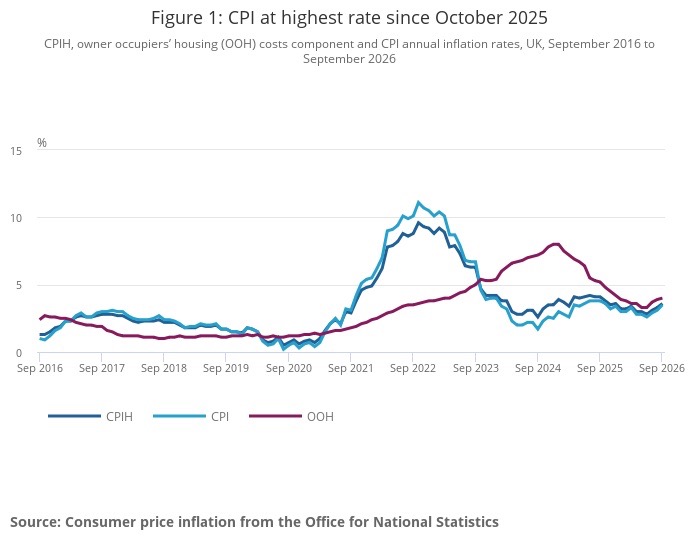
The 12 month rate of CPI inflation jumped to 3.5% in September from 3.1% in August, mainly due to higher fuel costs, ONS reported today.
ONS said that on a monthly basis, CPI rose by 0.4% in September 2026, compared with little change in September 2025.
The bump up in inflation was down to rising transport costs, mainly motor fuels which provided the biggest upward contribution to the monthly change in both CPIH and CPI annual rates.
Conflict in the Middle East has seen fuel costs rise rapidly over the past few months.
In contrast, restaurants and hotels made the largest downward contribution, partially offsetting the rise.
The sister Consumer Prices Index including owner occupiers' housing costs (CPIH) rose by 3.6% in the 12 months to September 2026, up from 3.3% the previous month. On a monthly basis, CPIH rose by 0.4% in September 2026, compared with a rise of 0.1% in September 2025.
The rises in inflation are well above the Bank of England’s target of 2% and may encourage the Bank of England’s Monetary Policy Committee to increase interest rates faster than planned, some experts said.
Core CPIH (CPIH excluding energy, food, alcohol, and tobacco) rose by 3.1% in the 12 months to September 2026, up from 2.9% in August. The CPIH goods annual rate rose from 2.7% to 3.2%, while the CPIH services annual rate rose from 3.6% to 3.9%.
Core CPI (CPI excluding energy, food, alcohol, and tobacco) rose by 2.8% in the 12 months to September 2026, up from 2.6% in August. The CPI goods annual rate rose from 2.7% to 3.2%, while the CPI services annual rate rose from 3.4% to 3.7%.
RPI, the older measure of inflation, rose from 3.4% in August to 3.9% in Sept.
Reaction to the rise has been one of concern but some believe the spike may be short lived.
Lucy Smith, senior investment manager at Killik & Co, said: “A rise in inflation reinforces the concern that price pressures are proving more persistent than hoped. With the IMF warning that inflation may remain higher for longer, and energy bills continuing to put pressure on finances, the rise will be particularly unwelcome. This will make it harder for the Bank to justify cutting interest rates, especially if higher energy costs begin to feed through more widely into prices.
"With just a week to go until Burnham’s first Budget, the Chancellor will now be under greater pressure to demonstrate that the government understands the scale of the cost-of-living challenge. A Budget that fails to offer some tangible relief risks a difficult reception, particularly if households feel rising prices are continuing to outpace their ability to recover financially.
"For investors, higher inflation could also keep gilt yields elevated and create further uncertainty around the outlook for interest rates and the wider economy.”
“The worry is that the longer the Middle East conflict continues, the greater the risk that elevated energy and fuel costs feed through into the price of other everyday goods and services, placing even more pressure on household budgets going into the winter.
“Today's figures will strengthen the hand of Bank of England policymakers arguing for higher interest rates when they meet in November. The difficulty there is that raising borrowing costs risks putting further pressure on consumers, without directly addressing the global energy prices driving much of the inflationary concern."